SETCO DC-4 (N-3423VX)
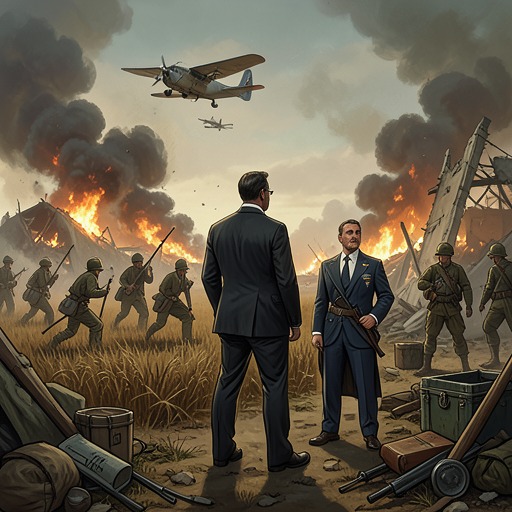
The Power of the DogThe SETCO DC-4 (N-3423VX) is a traceable aircraft at the center of Art Keller’s investigation into an airfreight operation connected to SETCO in Honduras. Its serial number turns a distant plane into a piece of evidence: it appears in a photograph from a jungle airstrip, leads through a corporate-paper trail to SETCO, and is later seen landing at a remote desert location. The book does not establish the cargo aboard this particular flight, but places the aircraft within a larger system built to move contraband across borders by air.
Identification and Connection to SETCO
Art records the DC-4’s serial number as N-3423VX while trying not to alert his target before the investigation is ready. His intended approach is incremental: work outward from the street and the aircraft, then inward toward the person behind them. The plane is thus both an investigative lead and a way of tracing a concealed operation without immediately confronting its suspected controller.
The paper trail assembled by Shag runs through holding corporations, shell companies, and assumed business names before ending at Servicios Turísticos, or SETCO, an airfreight company operating out of Aguacate Airport in Tegucigalpa, Honduras. The narrative presents the connection as the result of following the aircraft’s identifying details through layers of corporate concealment. Honduras’s established place in the drug trade gives that destination a wider historical context, but the immediate significance is practical: a numbered DC-4 can be linked to a named company and a base of operations.
Photographic Evidence and the Desert Landing
A grainy photograph laid before Art shows an airstrip in the jungle and several men standing around a DC-4 bearing the serial number N-3423VX. Art recognizes Ramón Mette immediately. Another man produces only a faint recognition: middle-aged, with a short military haircut, fatigues, and highly polished black jump boots. The photograph does not explain the men’s roles, but it supplies a visual link between the aircraft, Mette, and a group gathered at an isolated landing site.
A later operation makes the plane’s use more immediate. At night, a pilot flying eight thousand feet above the desert struggles to find an airstrip in the darkness. He has limited fuel and may soon have to turn back toward El Salvador. After trying the radio again, he reaches the correct frequency and receives instructions. On the ground, Shag runs to a truck, starts the engine, and blinks its lights; the aircraft’s running lights answer. Within two minutes the DC-4 descends from the darkness and lands smoothly. The sequence shows how a remote landing depends not simply on the aircraft but on coordinated guidance from the ground.
Art then opens the door where the pilot is being held. The pilot is Phil Hansen, who appears unexpectedly composed and treats the encounter as though it were a minor inconvenience. He recognizes Art and addresses him casually. The landing has therefore ended not in an ordinary arrival but in an interception: the aircraft has been brought down safely, and its pilot is now in Art’s custody. The scene makes the plane a point where an elusive air operation becomes physically accessible to investigators, even though the evidence provided does not specify what the DC-4 carried on that trip.
Place in the Federation’s Transport System
The aircraft’s importance is clarified by the broader logistics described in the book. After Operation Condor dispersed Sinaloan operators, the Federation’s advantage came increasingly from transporting drugs rather than growing them. Art understands the border itself as the durable commercial asset: cocaine can be worth vastly more on the United States side than just across the line in Mexico. In the arrangement with the Medellín Cartel and Cali Drug Cartel, Colombian suppliers pay the Federation one thousand dollars for each kilo safely delivered inside the United States. Mexican operators take delivery, move the cocaine to staging areas near the border, carry it into American safe houses, and return it to the Colombians for processing and distribution.
This account places air freight within a transnational chain, but it does not prove that every stage—or the particular cargo on the DC-4—belongs to this aircraft. The plane’s documented link to SETCO and its operation from Honduras nevertheless make it legible against a network in which aircraft can connect distant supply points, staging areas, and covert landing sites. Its significance lies in the infrastructure it exposes: transportation, corporate fronts, communications, and ground coordination are as consequential to the trade as the drugs themselves.
A Material Link in a Wider Exchange
The aircraft also belongs to a period when the Federation’s transport capacity supports a broader circulation of commodities. Adán Barrera agrees to a weapons-for-cocaine arrangement with FARC: one rifle corresponds to one kilo of cocaine permitted for sale from FARC territory, with heavier weapons valued at more kilos. In a separate negotiation with the People’s Liberation Army, Adán insists on paying in American dollars. He describes a cycle in which dollars buy weapons in China, weapons go to Colombia in exchange for cocaine, and cocaine returns to the United States to generate dollars.
These arrangements illuminate why air transport carries strategic weight in the novel: the same kind of logistical capacity can serve a trade that moves drugs, weapons, and money between countries. The text does not identify the SETCO DC-4 as the aircraft used for either weapons deal, so it remains a concrete investigative lead rather than a confirmed vehicle for every transaction. Its serial number, corporate trail, photographed appearance, and nighttime landing give that larger system a specific physical form—one plane whose movements can be followed, and whose arrival allows Art’s investigation to close in on the people operating around it.